

Noticed a dip where you sleep when you make the bed in the morning? Here’s how to tell normal body impressions from a sagging mattress, how to even out the dents, and when it’s time to start shopping for a new bed.
Quick answer: shallow dips where you and your partner sleep are usually body impressions. They form as the comfort layers on top of your mattress settle to your shape, and they’re normal. Sagging is different: the whole bed dips towards the middle, you feel like you’re lying in a hammock, and the support underneath has given way. Rotating your mattress regularly helps even out body impressions, but a sagging mattress usually needs replacing.
Body impressions vs sagging: how to tell the difference
| Body impressions | Sagging | |
|---|---|---|
| Looks | Shallow dips where each person sleeps, often with a slight ridge in between | The bed is visibly lower towards the middle |
| Feels | Little or nothing once you’re lying down | A hammock feeling, with your head and feet higher than the rest of you |
| Cause | The top comfort layers have settled to your shape | The support underneath can no longer hold you up properly |
| Next step | Rotate the mattress regularly and keep using it | Check your base and warranty, then plan to replace it |
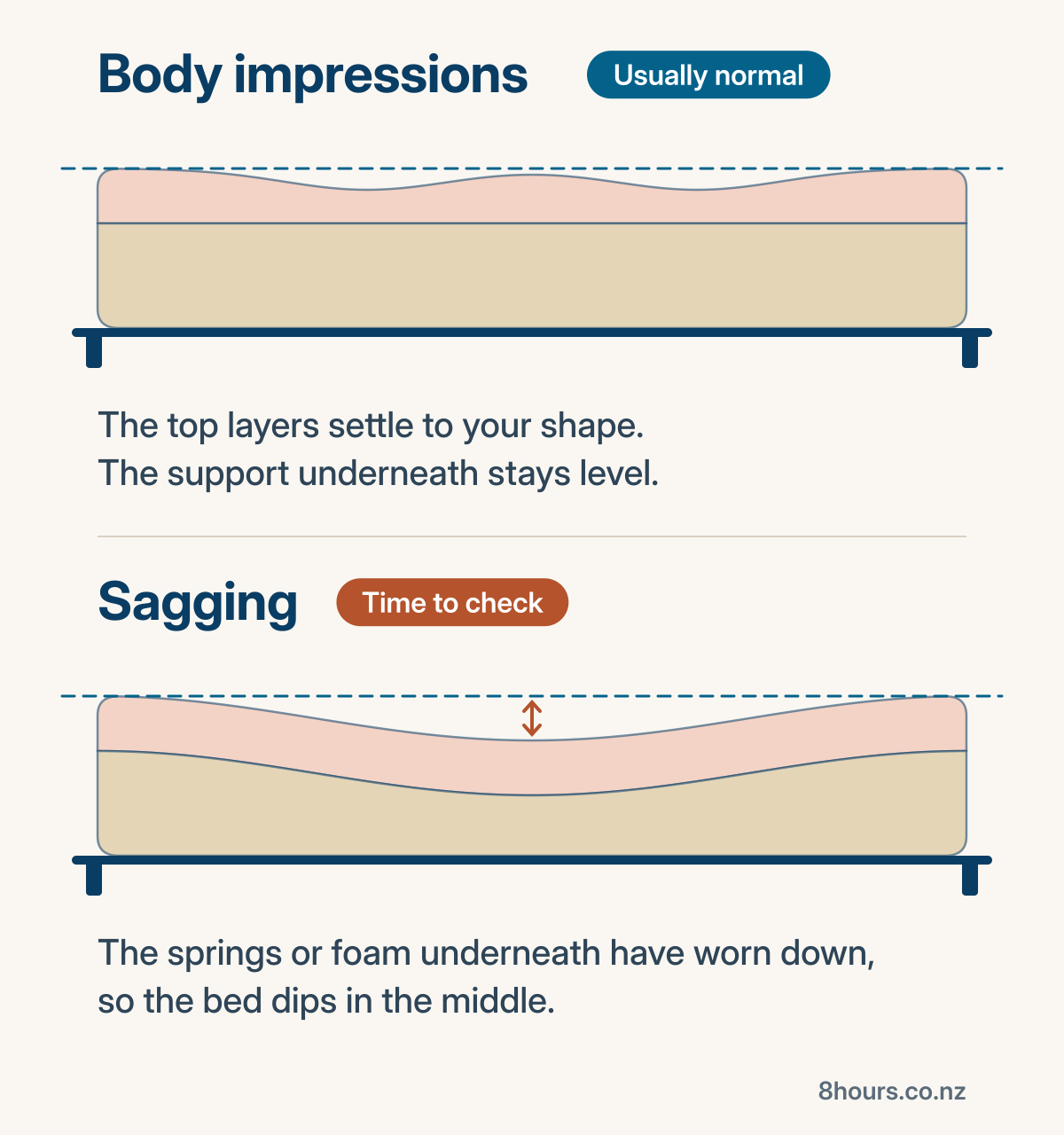
When you make your bed in the morning, you might notice indentations where you and your partner sleep. These are body impressions. When you get into bed you usually won’t feel them, because they only affect the top layers of the mattress. They tend to show most on mattresses described as plush or soft, because those have the deepest cushioning layers.
Sagging is a different story. The bed looks lower towards the middle, and when you lie down there’s a feeling of being in a hammock. UK impartial advice service Bed Advice UK describes a collapsed or sagged mattress as having a distinct lack of support, almost as if you can feel right through to the bottom of the mattress. When a bed starts to sag like that, it’s near the end of its useful life.
Why body impressions happen, and why they can be a good sign
Most modern mattresses have a spring system for support, topped with layers of foam or fibre for cushioning. Every night your body presses into those comfort layers, and after a while they start to take on your shape. That isn’t a bad thing. It’s a bit like a new pair of running shoes that get more comfortable after a few long runs.
Bed Advice UK says this settling usually shows within the first few weeks, most of all at the shoulders and hips, and that settlement on its own is not a sign the mattress is failing. A mattress with generous comfort layers should be expected to show body impressions. How much depends on things like your weight, the type and amount of filling, and the firmness of the mattress.
Bigger beds can look worse. Bed Advice UK notes that on larger mattresses the strip down the middle often doesn’t get slept on, so its fillings stay plump, which makes the dips on either side look deeper. If you’re weighing up sizes, our guide to NZ bed sizes has the measurements.
How deep is too deep?
There’s no single answer. Bed Advice UK says there is no official industry standard for when settlement becomes excessive, and that the measuring systems some makers and retailers use should only be treated as a broad guide. Mattress makers set their own limits in their warranty terms. The Sleep Foundation notes that warranties generally cover manufacturing defects, that deep, lasting impressions or early sagging may be covered, and that normal wear and tear usually isn’t. If you’re worried, measure the dip with the bedding off, check your warranty and care card, and talk to the store you bought it from.
How to even out body impressions
If you love the look of a perfectly smooth bed, there are a few things you can do.
- Rotate your mattress head to foot. This is the big one. Follow the care instructions that came with your mattress, because schedules vary. The care instructions from NZ bedding brand Dreamland, for example, say its mattresses are single sided and should be rotated every two weeks for the first four months, then every three months. If you don’t have any instructions, Bed Advice UK suggests rotating a one-sided mattress weekly for the first three months, then monthly.
- Spend time in the middle of the bed. If you sleep with a partner and there’s an uncompressed strip between you, make a point of squashing it down at every opportunity. Watch TV, read or nap in the middle of the bed to help those central comfort layers settle too.
- Dress your bed differently. Go for the plenty-of-pillows-plus-comforter look. A mix of textures and patterns makes a bed look inviting and does a good job of hiding subtle dents.
- Check your base. The Sleep Foundation says a worn or unsuitable base can contribute to sagging, for example slats that are too far apart or too little support in the centre. Check your base matches what your mattress maker recommends: Dreamland’s care instructions, for instance, list what the bed base needs for its mattresses.
Can you flip your mattress instead?
Once upon a time, mattresses were made to be flipped, and some even had a summer side and a winter side. Most modern mattresses have their comfort layers on top only, so the other side might be fantastically flat, but it will also be horrendously hard to sleep on. The Sleep Foundation advises against flipping most mattresses unless the maker specifically recommends it. Rotate it instead.
What to do about a sagging mattress
A sagging mattress means the support system can no longer hold you up properly. If there are two of you in the bed, you’ll often notice a roll-together effect, where you’re both pulled downhill into the middle. It doesn’t make for a good night’s sleep.
Unfortunately, you can’t really fix sagging. The Sleep Foundation says the only true fixes are a repair by the manufacturer or a new mattress. In the meantime, a few things can help:
- Check the warranty. If the mattress is still covered, contact the store or maker before you try anything else.
- Check the base. A tired or poorly supported base can make a mattress dip, so it’s worth ruling that out.
- Add a topper. A thick, dense topper can make a sagging bed more comfortable for a while, but it won’t fix the sag underneath.
- Rotate it. Turning the mattress head to foot puts the heavier parts of your body on areas that haven’t dipped yet.
If your mattress has lumps and bumps or creaks, or you’re waking up stiff and sore, Bed Advice UK suggests it might be time for a replacement. If aches carry on, see your GP. For more signs it’s time to go shopping, see our post on Banana Bed Syndrome and other signs you need a new mattress.
When you do shop, think about how you sleep. In a pocket spring mattress the springs are individually wrapped so they move independently, which is designed to reduce motion transfer between two sleepers. You can browse Dreamland’s mattress range online, then try a few in store before you decide.
Body impressions FAQs
How do I get rid of body impressions in my mattress?
You can’t usually remove them completely, but you can even them out. Rotate the mattress head to foot on the schedule in its care instructions, spend some time in the middle of the bed, and check that your base gives the mattress even support.
Why does my mattress have a dent where I sleep?
Most dents are body impressions: the comfort layers settling to your shape, usually most at the shoulders and hips. That’s normal. If the whole bed dips in the middle and feels like a hammock, it’s sagging instead.
Are body impressions covered by a mattress warranty?
Normal settling usually isn’t, because it’s expected wear. Deep, lasting impressions or early sagging may be covered, depending on the maker’s terms, so check your warranty and talk to the store you bought from.
Should I flip my mattress to fix a dip?
Only if it’s a two-sided mattress made to be flipped. Most modern mattresses are one-sided, so rotate them head to foot instead.
Will a mattress topper fix a sagging mattress?
No. A thick, dense topper can make a sagging bed more comfortable for a while, but it won’t fix the support underneath.
Try before you buy
If it’s time for a new mattress, lie on a few before you decide, ideally with your partner. You can find a Dreamland stockist near you. Ranges vary by store, so it’s worth calling ahead.
Sources: Bed Advice UK FAQs; Bed Advice UK, Caring for your bed; Sleep Foundation, How to fix a sagging mattress; Sleep Foundation, Mattress warranties.
Edited by Quill, 8 Hours editor
Last updated: 22 October 2026
Originally written by Jo Joiner, updated by Quill, the AI editor of 8 Hours, then checked and approved by a person on the 8 Hours team.
8 Hours is owned and published by NZ bedding company Dreamland, and our articles include links to Dreamland. We aim to give advice that is useful whichever brand you choose.